
When I was a young boy, my parents told me there were no such thing as ghosts. Growing up I really believed that. That's pretty crazy, right? Now we know ghosts are quite real and many famous trainers specialize in training the ghost-type Pokémon. It was Professor Oak and Elite Agatha who first speculated the existence of the ghost-type and it was because of their theories and the strange happenings going on at Pokémon Tower that they sent me, and Blue before me, to investigate and uncover the truth. I don't know what Blue endured within the tower before I got to Lavender Town, but I know he realized the prototype Silph Scope was absolutely necessary to see just what was really going on inside. I didn't know what I'd find inside, but I was confident that it wasn't going to be ghosts. They weren't real.
Professor Oak had sent me some urgent messages that I picked up at the Pokémon Center in Lavender. They sounded quite desperate. Apparently some of the other field research teams that he had dispatched to the tower had met with disaster. They had all abandoned the project. The rumors around town that whatever was going on inside the tower had involved Team Rocket somehow which I'm sure prompted Blue to take action in Celadon. It also explained why the Silph Scope was found among their stolen experimental devices in their headquarters.
"The tower is closed to the public until further notice," the attendant at the front counter told me as I entered the site. "Mr. Fuji is quite adamant that no one else be allowed to enter until a thorough investigation has been conducted."
"I was sent by Professor Oak," I stammered, hoping it would give me enough credibility to proceed.
"So were most of the others," she replied. "They didn't last very long inside. Neither did those Team Rocket members who forced their way in soon after. The tower is too dangerous right now."
"How so?" I asked. I knew the tower was used as a memorial for Pokémon that had passed on, but all the chatter around town of ghosts lurking in the darkness just seemed ridiculous to me. Ghosts weren't real.
"There was a team from Saffron City that went in about a week ago. Not a single one of them has come back. I personally won't even set foot on the first step up those stairs," she said motioning to the large winding stairway that worked its way up the floors of the tower. "Just forget about it and go home. I'm sorry if you lost a Pokémon dear to you, but it's just not safe up there."
She wasn't going to budge on the issue, but as far as I knew the tower was an open building day and night. There was no front gate, no locked doors, nothing to bar entry once this attendant had gone home for the night. Professor Oak's researchers had failed. Team Rocket had fled. Blue certainly wasn't inclined to come back after whatever happened to him. Not to mention a team of investigators from Saffron City had disappeared inside not too long ago. I needed to know what was going on inside and I was the only one with a Silph Scope that Blue assured me was necessary. So I waited patiently discreetly down the street from the path winding up to the Pokémon Tower and waited for night to fall.
As I had surmised, the tower was completely unguarded at night. The troubling rumors and the fact that it was a Pokémon graveyard probably kept most of the townsfolk far from the tower at night. I was the only one dumb enough to set foot inside after dark, and as soon as I stepped off the stairs my heart was racing. Even though it was early May and summer was just around the corner, the air was chilled. Even so, I was sweating up a storm as I crossed the first floor towards the next set of stairs leading up to the third floor.
The tower was dimly lit. Small candles burned on the memorials that were left for lost Pokémon, but there was no other light source. There were windows along the edges of the tower, but for some reason the moonlight was not making its way inside. As I passed by the memorials, I wondered, who had lit these candles if no one was allowed up here? I convinced myself that it must have been the team from Saffron City that were still lingering in the tower for whatever reason. I tried not to ask myself how they had survived for a week without access to food or water. Certainly they must have brought enough supplies. Right?
As my nerves began to falter, I popped the Silph Scope down over my eyes and glanced around. I was hoping they'd allow me to see better in the darkness, but sadly they did not. Everything looked normal through the lenses of the Silph Scope. Still, I wouldn't take them off now that they were on. They brought me some small amount of comfort and that was enough to get me to take those steps up to the next floor. It made me feel safe at first, but that began to dwindle with every passing moment spent in the tower.
Every passing step up across the floors of the tower and I felt a huge weight on my stomach pressing down and making me feel ill. I began to grow more and more terrified, jumping at every shadow flickering in the candle light. Eventually I felt like I was moving at a snail's pace as I made my way up the flights of stairs and across each new floor. It was deathly silent in here. Aside from the lit candles, that I hoped were being maintained by the Saffron crew, there was no sign or sound of anyone else inside. I felt tremendously alone.
It wasn't until the third floor that I realized I wasn't alone. I tossed out Dustin's Poké Ball and he was instantly on alert. I don't know what spooked him, but it didn't reassure me much. Still, I was glad to have the company as Dustin pressed forward one step ahead of me. Thanks to knowing the useless Pokémon move "Flash" Dustin's eyes managed to illuminate the darkness just a bit better than the candles, but a gloom still clung to the place.
I was certain we were being watched and Dustin seemed to agree. His eyes darted from corner to corner, lighting them up like a flashlight. As we progressed he would often stop and jerk his head around to peer into the corners behind us, as certain as I felt that there was something there. Neither his psychic prowess or my Silph Scope revealed anything, though. Whatever was lurking out there was quick to elude us and by the fifth floor, I think Dustin was making me more nervous than comforted with his erratic scanning of every dank nook and cranny of the tower.
Stepping off the stairs to the sixth floor, I could hear faint laughter or perhaps weeping coming from the final floor above us. It froze Dustin and I in our tracks. I saw him tilt his head as he reached out to probe with his mind. I envied him a little, but he didn't seem reassured much by whatever his psychic scan revealed. The noises from above confirmed that we were not alone and that disturbed both of us. The hairs on my neck were standing on end and my entire skin was covered in goosebumps by this point. I could see my breath in front of my face in the dim candle light, even though it really shouldn't have been that cold. Every instinct in my body told me to run back down the tower and out into the safety of the moonlit night, but I'd come too far. I'd faced down Team Rocket just two days ago and I wasn't about to let some laughing or weeping creature scare me away from this tower.
I almost wish it had, though. What awaited above in the darkness haunts me still. I've never seen anything like it before or since. As Dustin and I crossed the threshold of the seventh and final floor of the tower, we found ourselves surrounded by bodies - human bodies. They were strewn about the room like rag dolls that had been tossed aside, draped up against the walls and memorials, unmoving in the flickering candle light. The laughter, and I was confident it was laughter now, seemed to be coming from all around us. I couldn't tell if it was coming from one of the bodies on strewn across the floor or not. It wasn't until I looked at Dustin, who was staring intently up at the ceiling, that my stomach dropped and I slowly followed his gaze upward.
"Have you come to play?" A young woman was clutching the ceiling like some kind of spider or lizard, crouched on all fours, but staring down at us from across the room. Her face and neck were contorted in ways that didn't look natural or comfortable and her mouth was in a wide, sneering grin. "My other dolls are broken now, and this one will soon be useless, too." The voice was seething, but held a hint of laughter.
The girl dropped from the ceiling like a rock, but managed to contort herself in midair like a cat to land soundly on her bare feet and the palms of her hands. I could see she was wearing what remained of a very tattered dress, or perhaps tattered red hakama of a shrine maiden. Her wiry black hair fell around her face like a frame, but her grin did not change from the mocking crescent moon she held when we first saw her on the ceiling. "Answer me!" She insisted.
"I'm not here to play," I shouted back. I don't know where the words came from because I was trembling with intense fear.
"You never had a choice!" she screamed and rushed forward at insane speed. Fortunately Dustin raised his right hand, a pendulum forever swinging in his left and the girl was thrown backwards across the room, slamming harshly into the wall. It was then that I saw it through the Silph Scope. It wasn't the girl that Dustin had attacked, but something inside her. A dark purple mass was attached to the girl and I could see the grin fade from her mouth as it began to coalesce behind her.
"Help me," she gasped in a strained, but normal sounding human voice.
"Dustin! Hit it again!" Dustin took a step forward with his palm extended and I could feel a shock wave of his Confusion psychic attack blast whatever creature had hold of this young woman. This time she was freed entirely and her body fell to the floor in a heap. What remained was a round, dark purple Pokémon with large eyes with red sclera surrounding little black pupils. It held that same sickly wide grin that was splashed horrifically across the girls face. I was looking at a ghost - a ghost Pokémon which until recently had only been theorized.
It looked at me and Dustin with some disbelief behind its twisted grin. It apparently didn't expect to be pushed out like that. Dustin protectively stood between me and the creature. Before my eyes, two more creatures materialized out of apparently thin air. One of them a gaseous purple and black ball with eyes and a mouth, the other a floating purple apparition with two detached purple hands floating in front of it. I was all but locked up in terror at this point, but Dustin and I both knew that I was in danger.
Dustin sized up the opponents squarely. His gaze passed from one to the other. Finally I urged him to action. He hypnotized the gaseous orb which the Pokédex would come to identify as Gastly and it slowly drifted down to the floor in sleep. I quickly tossed out a Poké Ball to capture it if I could and get it off the battlefield. I didn't have time to see if it was successful as the apparition with disembodied hands lunged forward with a gigantic tongue rolling out of its gaping maw. It looked as though it were going to lick Dustin, but he was having none of it. Confusion absolutely decimated the apparition later identified as Haunter. It left only the original creature, the leader of this mischievous trio, staring coldly at us across the room.
Dustin and the Gengar appeared to be having some kind of intense staring contest and for a moment I wondered if they were engaged in some kind of psychic battle. It was unfortunately too late that I realized this ghost Pokémon was using one of my beloved techniques against us! Dustin was sound asleep and this creature was somehow feasting on his dreams and gaining strength. How could I have been so stupid? I fumbled for Dustin's ball to withdraw him and protect him, but before I could, a faint sound came trickling in from somewhere. It was the soft sound of a flute.
I didn't have time to be puzzled by this because Dustin was instantly awake and taking action. He leaned forward to send a final blast of Confusion at the Gengar which squealed in pain and then suddenly vanished into the night. The candles flared up dramatically, enveloping the whole room in bright light before returning to a normal, healthy glow. The gloom that had been hanging around this place had been lifted. I saw the faint blinking light of my Poké Ball and knew I had captured that one gaseous orb. I took a deep breath and felt like a huge weight had been lifted. I'd forgotten completely about the faint flute music.
"Are you all right?" I asked rushing over to the young woman who had been tossed backwards by Dustin's psychic attack.
"I am now," she said in an exhausted tone. "Thank you."
I didn't really know what to say. Dustin had done most of the work. I had been practically frozen in fear. I helped the woman to her feet. She looked around at the other bodies. She frowned.
"They are alive," she said. I wasn't sure how she knew what I was asking in my head. "I can sense them breathing, dreaming. They are just weak. That Pokémon was playing with us like toys and draining our energy. We might not have made it much longer if you hadn't shown up." Her voice was raspy and quiet.
"Stay here with your friends," I said. "I'll go get help."
"No need!" came a loud voice from the stairway. Dustin, the girl and I all snapped our heads in his direction, surprised by the announcement. Standing at the stairs, we saw an old, bald man in a kimono beside an old woman in a purple and white dress leaning heavily on a cane. The man looked genuinely ecstatic while the woman had a dark grin spread across her face. "We saw you come in armed with that scope there and knew we had to follow. I'd been waiting for Agatha here for days to help me investigate the tower and it appears her predictions were correct. There were ghost-type Pokémon in here!"
"May I?" she asked, pointing at the Poké Ball that now held Spectre the Gastly. I handed it to her. I'd like to reiterate, I had no idea who I was talking to at the time. As a newcomer to Kanto, I didn't realize I was in the presence of two well known authorities on Pokémon in the region, one of them a member of the Elite Four. All I knew was I was exhausted from this ordeal and they were here to help. It had been a long night. In my exhaustion, I never even noticed the flute clutched in the old man's hands.
Current Team:
Attacks in Blue are recently learned.
Current Team:
Bill's Storage: Kiwi (Pidgeotto), Vesper (Zubat), Spectre (Gastly)
Old Man Daycare: Charlie (Pidgey)
Thursday, March 5, 2020

Wednesday, March 4, 2020
Games Course Alumni Shares His Top Tips On Art Projects.
A big 'Thank you' goes out to our Alumni, David Woodman, who has shared some of his top art tips on ArtStation for our students to learn from his many years of experience as a 3D artist and Art Director in Research and Development at TT-Games!
Top Tips.
You can also see examples of David's work n his ArtStation portfolio.

Top Tips.
You can also see examples of David's work n his ArtStation portfolio.

MT 5662, Tron Deadly Discs!
Happy New Year! The first episode of 2019 is all about Tron Deadly Discs, by M Network, a tiny little division of Mattel Electronics. Please stay tuned to the feed for an interview with programmer Jeff Ronne. I enjoyed talking with him and I hope that you will give it a listen. Next up will be Pengo by Atari. If you have any feedback for Pengo, please get it to me by the end of the day 20th January. You can send it to 2600gamebygame@gmail.com.Thank you all so much for listening!
Tron Deadly Discs on Random Terrain
Jeff Ronne on Quora
Takeover on Intellivision Lives
M Network decal card on Atarimania
Tron Deadly Discs on Intellivision Lives
Encom 2600 mod by Russ Caslis
Atari Bytes 153 - Mega Force the Movie!
Tron for 2600 Atari Age Thread
Only Solutions by Journey
Tron Deadly Discs on Random Terrain
Jeff Ronne on Quora
Takeover on Intellivision Lives
M Network decal card on Atarimania
Tron Deadly Discs on Intellivision Lives
Encom 2600 mod by Russ Caslis
Atari Bytes 153 - Mega Force the Movie!
Tron for 2600 Atari Age Thread
Only Solutions by Journey
Monday, February 24, 2020
Storium Theory: Optional Challenges
Most of the time, when we put down a challenge, it's definite - a note that the story will be focusing on a particular point. But is it possible to use challenges differently? To lay down a challenge for something the players might want to focus on, but are not required to focus on?
But should you decide to use this tool, I think there are some very important things you will need to be sure you address.
I believe it is a tool for the toolbox...but one I would show great caution in using. I've only pulled out an optional challenge once or twice in my own games, and I am wary of using them often, if at all, in my own narration generally. Storium's rules are set up more for completion of challenges and requiring of challenges, and I think there's a good reason for that.
In setup, an optional challenge wouldn't be so different from a regular challenge - you still want to establish the starting situation, the facts of the challenge, and the possible places the challenge can end up once it is complete. There's not much different in the overall technique of setting it up.
But should you decide to use this tool, I think there are some very important things you will need to be sure you address.
First: How will you know if players are or are not going to play on the challenge? You will need a good way of knowing if players have not played on a challenge yet because they haven't gotten to it yet, or because they do not intend to play on it at all. An optional challenge, being optional, could be ignored completely by players for reasons that have nothing to do with slow play or inactivity. It is important to have a way of determining that the players are not going to play on the challenge, and that it is time to move the scene on.
I suggest that you consider one of the following ideas:
- Set a deadline based on the other challenges - if the optional challenge is not completed by the time the scene's other challenges are, you will consider it incomplete and move the scene on.
- Set a deadline based on actual time - if the optional challenge is not completed within X days after the rest of the scene's challenges are (or just within X days if there are no other challenges) you will consider it incomplete and move the scene on.
- Require an affirmative statement from a player that they intend to play on the optional challenge by a specific date. If you have no such statement by that date, you will remove the optional challenge.
These methods are probably not the only ones...or even likely the best...but they all allow you to know when you can regard the challenge as incomplete and move forward. Whatever choice you make, be sure you tell your players so they know what the requirements are.
Second: What happens when the optional challenge is incomplete?
This is a pretty important question, and one that, I think, gets at the reason I don't use optional challenges much. If something's critical enough to the story that you want to set up a challenge for it, it seems like it is something the group should have to interact with - even if their interaction is playing Weakness cards and having their characters utterly ignore it and let it go wrong. In other words, the characters might not care about something, but if it is important enough to the story to rate a challenge, the players should have to do something about it...even if that something is having their characters do nothing. The story of the challenge, once laid out, should probably progress.
If it goes well, then, it ends Strong. If it goes poorly, it ends Weak. If it is less clear, it ends Uncertain. But that's all determined by the cards.
So...what do you do with a challenge that seemed interesting enough to put out there as an option, but that seems like something the character's don't have to address?
My best bet is that you do nothing. An optional challenge is something that is interesting, but not critical. The players don't gain or lose anything by not going after it. It's only if they actually engage it that it matters to the story in any way.
Thus, if the players don't seem interested in it and leave it alone, it just drops off for the moment. Nothing bad happens, nothing good happens. It just fades away into the background again.
That's not to say you can't bring it back again later, or bring it back again later as a normal, required challenge. It's just that for the moment, it wasn't critical enough to be made required, so nothing's reaching any kind of story-altering point with it. It just fades away for now.
If on the other hand players play some of the cards on the challenge, but don't finish it, I'd probably go by my usual rule for ending a challenge early when it becomes absolutely necessary: Most likely, end it by whatever the current result would be (i.e. if it is going Strong, it ends Strong, if it is going Weak, it ends Weak, if it is going Uncertain, it ends Uncertain) - this method makes the players' card plays so far clearly matter, so that's my preference. If you use a different rule for those cases in your own games, be consistent.
But that brings me to another consideration...
Third: How many points do you put on the thing, anyway?
I'm going to just say outright that I think the answer is one, possibly two at maximum. An optional challenge is not the focus of the scene - it is by definition something that can be entirely ignored. Thus, it isn't anywhere near as important as other challenges, and shouldn't get a lot of focus in the scene at hand.
Furthermore, if you put more points on an optional challenge, it makes it harder to judge when players no longer care about it - once it has become active, how do you judge that it isn't going to be active any further? You can always rule that an optional challenge becomes required if at least one player plays a card on it, of course, but that could get messy in terms of game morale and community if players disagree about whether they want to play on it.
So...I suggest making your life as easy as possible by using only one or two points, tops, and making clear to your players that whatever "deadline" you set for the optional challenge is a completion deadline, not a play deadline - the challenge needs to be complete by then or you will move things on. That will prevent an optional challenge from causing delays.
Finally, though: Consider whether the challenge should even be optional in the first place.
Most of the things I've considered as, well, optionally "optional" challenges were ideas that I ended up deciding would either fit perfectly well as required challenges right then, or would fit perfectly well as required challenges later. I've rarely come across something that I considered important to note in challenge form, but not critical enough to be something the players had to address.
If you're considering an optional challenge, think about it a bit more for a while...is it really something that should be optional, or is it just something that hasn't come to a head yet? Maybe it's something you can get some actual drama out of later, and make it a normal challenge in a later scene. Or maybe it's something you can hint at with a minor required challenge now - perhaps to see if someone notices something - and bring in more fully down the line.
Or perhaps it is something that actually is pretty vitally important right now, in which case it should be a required challenge...right now.
So, when can an optional challenge be helpful?
I could see them being useful if you want to allow the group to choose a direction, but neither direction is necessarily better or worse for the story (if one direction is better and the other is worse, you'd instead do a regular challenge and set the first up as the Strong outcome and the second as the Weak). Then, you could set up two different one-point challenges, and tell the players they can only do one of them - that sets them off on that path and determines how it starts out for them.
It isn't my chosen way to find where the players want to go in the story, but I could see it working.
Another method might be something that is solidly an opportunity for the players - again, if they don't do anything, it doesn't go wrong or anything like that, but perhaps it is something they can use to "shortcut" the plot in some way. You'd have to be careful with this one - it's easy to run into the "why don't you just do this as a regular challenge" internal question - but there are ways I could see it working. If you do this, then, the Strong result is very good for the characters, and the Weak result is perhaps less so, but still generally quite good.
The problem I run into myself with that is that if you use that method, it becomes hard to argue that things aren't worse if the player decide not to play the challenge...in which case, again, I feel like it probably shouldn't be optional because it impacts the story in a notable way. And that's exactly where I've ended up when I've reflected on the few times I've used optional challenges...I end up feeling like what I did was render a part of the story optional when it was actually going to have a definite impact.
And that's the point I keep coming back to myself in considering this - I just generally can't justify putting a challenge down and treating it as "optional." When I put a challenge down, it means that a notable event has started in the story, and the players, through their card plays, need to see where it goes. It needs to get to some conclusion or another, so that we know where the story goes after it. When I find myself thinking of perhaps telling my players a challenge is optional, I start instead thinking of whether it should be there yet at all.
But: I know that this is a technique some other narrators have used in the past, and I'd very much be interested to hear others' thoughts on it. Have you used optional challenges? What did they represent in your game? And how did you ensure that you knew it was fine to move the game forward? Write in, and let me know!
Sunday, February 23, 2020
Growing Esports.
 |
| Often the real prize is hidden by more the more 'showy' aspects. |
Imagine, if you will, growing a pumpkin plant. Every part of the plant is edible, yes, the leaves, the stems, the flowers, and the fruit.
Thus the gardener is immediately in a dilemna. Should the gardener decide to harvest the leaves, the plant immediately retards the production of flowers and thus the production of fruit. By doing the quick-gain, the gardener never gets to see the final product, unless by showing great restraint, never taking more than he/she should in order to allow the plant to generate enough flowers and fruit.
This is the choice in which all those involved in growing an esports organization are faced.
The leaves represent the short-term gains to be made. By only concentrating on the short-term gains, the organization, and the officials thereof, never see the final product. They lose sight of the overall picture (maybe they never had it) and only see the short term benefits for themselves. Such individuals push for every short-term gain, and not only endanger the organization itself, but run the risk of doing irreparable harm to the environment as well. Should the environment be damaged, it not only impedes the growth of the organization that has damaged such environment, but also the effects the environment in which the organizations that due pursue a greater vision operate.
The fruit of the plant thus represents the full vision. Esports, as a sport, has much to offer on every single level. That is if it is pursued to the full. Esports can produce not only employment for those directly involved in esports, but also employment in many auxilliary services.
More importantly, esports as an accredited sport, can lead individuals to their full potential in their gaming, academic, and business lives. Through the award of official colours, players are able to obtain bursaries and improve themselves.
By competing in strict official structures, players are able to develop character. Such character will help them through all the trials and tribulations of later life - and there will be many!
Thus Mind Sports South Africa (MSSA) has its eyes firmly set of the overall picture. While many veer off for personal aggrandisement and financial gain, MSSA remains true to its course of delivering to its members and ensuring that esports remains a true sport.
It was solely through MSSA's efforts that esports was accepted as a sport in 2005 and that Protea Colours were awarded to an esports team in the same year.
Also read:
Friday, February 21, 2020
Buds, Blooms, And Thorns Review Of Pluto Attacks! By JTP Games
Buds, Blooms, and Thorns Review of Pluto Attacks! by JTP Games
DisclaimerSupport me on Patreon!
 Vitals:
Title: Pluto Attacks
Designed by: Troy Pichelman
Publisher: JTP Games / The Game Crafter
MSRP: $25
1-6p | 30-45 min | 12+
Introduction:
DisclaimerSupport me on Patreon!

Title: Pluto Attacks
Designed by: Troy Pichelman
Publisher: JTP Games / The Game Crafter
MSRP: $25
1-6p | 30-45 min | 12+
Introduction:
What's better than a black and white, 1950's b-level sci-fi movie? Well, lots of things, but they are fun to watch. Pluto Attacks! lets you play through a classic sci-fi movie where aliens from Pluto are attacking a small town in 1954. As is the case in these situations, all the adults have been incapacitated so it falls to a group of teens to save the day.
Pluto Attacks! is a cooperative dice game for 1-6 players. You'll get to take on the role of a teenager in the small town working with your teammates to defeat the aliens before the end of the movie. The game plays through four acts with a new scene appearing every turn. Using skills and abilities you'll have to roll dice to match requirements for each scene to secure the location. Securing the location gives you certain abilities, but may also be required to resolve the final obstacles.
Blooms:
Blooms are the game's highlights and features. Elements that are exceptional.
Buds are interesting parts of the game I would like to explore more.
Thorns are a game's shortcomings and any issues I feel are noteworthy.
Buds, Blooms, and Thorns Rating:
Pictures:


Pluto Attacks! is a cooperative dice game for 1-6 players. You'll get to take on the role of a teenager in the small town working with your teammates to defeat the aliens before the end of the movie. The game plays through four acts with a new scene appearing every turn. Using skills and abilities you'll have to roll dice to match requirements for each scene to secure the location. Securing the location gives you certain abilities, but may also be required to resolve the final obstacles.
Blooms:
Blooms are the game's highlights and features. Elements that are exceptional.
- Light, fast play is great to pull out as a filler or when you need a casual game.
- Theme is dripping from the game. All the artwork, mechanics, and flavor really hits the spot with the b-movie theme.
- The game has a great story arc. It's not a story game, but the way the game escalates through three acts to the final conflict is great. I've won most of the games I've played, but every one has come down to the wire and ended in a pretty tense finale.
Buds are interesting parts of the game I would like to explore more.
- There are a ton of different combinations for Scenes, Plot Twists, and Big Reveals so every game will tell a different story.
- There's an optional playmat that looks great and really helps with the game layout and theme immersion.
Thorns are a game's shortcomings and any issues I feel are noteworthy.
- The game does have a very high amount of luck. In addition to the dice rolling, having the cards you need to complete the win condition stated in the Big Reveal relies on the luck of the shuffled scene cards. If the cards you need to win are further down in the deck it'll be harder to survive long enough to win.
- There's not much you can do to mitigate poor dice rolls, especially earlier in the game. Having some way for characters to "level up" and gain skills would be great. Maybe when a Plot Twist card is removed it could give players a certain skill. like "reroll 1s" or "decrease one die by 1 to increase another die by 1". Some of these could even be specific to the type of card they are, like "reroll all dice once when resolving a science location". Other aspects of the difficulty may have to be increased because I think the balance is good as it is, but a feeling of a little more control would help feel like your characters were growing along with the story.
- Sometimes it feels like each turn is solo and there's not much cooperation, especially before you know what the win requirements are for the Big Reveal. Until then you really won't want to discard any cards to help out others or even yourself just in case those cards are needed at the end. I wish there was a better sense of cooperation and way to mitigate dice rolls earlier in the game.
I first played Pluto Attacks! at Protospiel Chicago in 2016 and again at Protospiel Milwaukee in 2017. It's made the rounds to quire a few other Protospiel events as well. I've since played my copy a few times, too, and have enjoyed every game I've played. Over the years the game has gotten better since my first play, too, with more cooperation opportunities available, improved artwork, and some refined mechanics. I do wish the cooperation aspect was pushed a bit more and that there was a little more control and luck mitigation, but the game as it currently plays is fast, fun, and easy to explain. It's a great game to pull out as a filler or with more casual gamers. I really like the sense of progression through the story like you'd have in a movie. The players are confronted with a series of setbacks, while they try to just survive and the town slowly falls to the invaders. Then they figure out what they need to do to defeat the aliens and get down to work trying to save the last remaining pieces of the town while collecting what they need to fight off the attack once and for all.
Every game I've played has come right down to the wire, so the balance seems great - no small feat for a game that relies so heavily on lucky dice rolls. Played right, you'll reach the game's conclusion with enough options for mitigating bad luck in those final dice rolls, hopefully. When you lose though it's easy to blame bad luck with the dice and cards that happened to come out. I wish there was something that gave you a little more control, or at least sense of control, especially as the game ramps up. As a dice game there's no escaping the luck factor, but giving the players a few more possible tools for mitigating the dice would be fun.
Overall though, I really like Pluto Attacks! for a light, casual game. The theme is fun, the mechanics reflect the theme wonderfully, and it's always a fun time with an exciting end. This isn't a collection essential, but if you like the idea of this you won't be disappointed.
Every game I've played has come right down to the wire, so the balance seems great - no small feat for a game that relies so heavily on lucky dice rolls. Played right, you'll reach the game's conclusion with enough options for mitigating bad luck in those final dice rolls, hopefully. When you lose though it's easy to blame bad luck with the dice and cards that happened to come out. I wish there was something that gave you a little more control, or at least sense of control, especially as the game ramps up. As a dice game there's no escaping the luck factor, but giving the players a few more possible tools for mitigating the dice would be fun.
Overall though, I really like Pluto Attacks! for a light, casual game. The theme is fun, the mechanics reflect the theme wonderfully, and it's always a fun time with an exciting end. This isn't a collection essential, but if you like the idea of this you won't be disappointed.
 |
| Bud! This game definitely has some great moments. It's good for several plays and should appeal to most gamers, especially if you enjoy other games like this. |


Did you like this review? Show your support: Support me on Patreon!Also, click the heart at Board Game Links  , like GJJ Games on Facebook
  , or follow on Twitter
  . And be sure to check out my games on Tabletop Generation.
GJJ Games Reviews are independent, unpaid reviews of games I, George Jaros, have played with my family and friends. Some of these games I own, some are owned by friends, some are borrowed, and some were provided by a publisher or designer for my honest feedback and evaluation. I make every attempt to be both honest and constructively critical in my reviews, and they are all my opinions. There are four types of reviews on GJJ Games: Full Reviews feature critical reviews based on a rubric and games receive a rating from 0 to 100. Quick Reviews and Kickstarter Previews are either shorter reviews of published games or detailed preview reviews of crowdfunding games that will receive a rating from 0 to 10 based on my impressions of the game. Buds, Blooms,and Thorns reviews are shorter reviews of either published or upcoming games that highlight three aspects of a game: Buds are parts of a game I look forward to exploring more, Blooms are outstanding features of a game, and Thorns are shortcomings of a game. Each BBT review game will receive an overall rating of Thorn, Bud, or Bloom.
, like GJJ Games on Facebook , or follow on Twitter . And be sure to check out my games on Tabletop Generation.Thursday, February 20, 2020
Valfaris Review (NSW)

Written by Patrick Orquia
Title: Valfaris
Developer: Steel Mantis
Publisher: Merge Games
Genre: platformer, action adventure, hack 'n slash
Number of Players: 1
Release Date: 10 October 2019
Platform: Nintendo Switch
Price: $24.99
Also Available On: PS4, Steam, XB1
Developer Steel Mantis has yet again delivered an unholy marriage of retro-styled video game and heavy metal with their latest offering, Valfaris. A follow-up (but not a sequel) to Slain, this game features a warrior hero slashing and gunning enemies with much ferocity and fury, backed with a pounding heavy metal soundtrack. Whereas Slain is set in a gothic, Casltevania-esque world, Valfaris is science fiction-themed, with the aforementioned here out to rid his home planet of Valfaris of alien creatures.

The game is presented in a retro-inspired 16-bit graphics, but not too pixelated. The art style is reminiscent of the illustrations used on metal albums from the 80s and 90s. Yes, this game is like sci-fi meets hair metal, and it's awesome. Everything is animated rather rigidly to somehow look like a game from the 80s, but the game runs at a sold 60FPS. That kinda doesn't make sense, but you have to see and play the game to get what I mean. And of course, the music is also metal AF. Like in Slain, most of the soundtrack comprise of heavy metal tunes, with all of their double pedal and fast guitar-riffing glory. This makes killing enemies more exciting and tense.
In this game, you play as Therion, long-haired warrior aboard a spaceship on his way to his home planet, Valfaris, after it re-appeared in orbit of a dying star. This planet is now invaded by monstrous alien life forms and his arrival is not welcome at all. Right on the get go, the mission is to kill or be killed. Armed with your trusty pistol, sword, and another heavy gun, your aim is to reach the end of a level, where a big boss fight awaits you. Along the way, altar-like structures that act as save points are situated, but you cannot save your progress if you don't have a green resurrection medal, which is one of the collectibles in this game. If you die, and you will die many times, you will spawn back at the last save point where you saved. They could be far in between and this could be very frustrating as you fight the same enemies and tackle the same traps or platforms over and over again, but each time you do, you learn bit by bit.

Memorization of enemy position and attacks and platform movements is the key to beating them. The enemies telegraph their moves quite clearly, so you need to react accordingly when they are about to strike. But of course, that is easier said than done, as oftentimes, you will be battling against multiple enemies at once, and each one of them attack individually, making it hard to focus on just one enemy while evading the others. Therion can defend by putting up a shield, which consumes stamina when the shield is hit. If done right before a projectile is about to hit Therion, you can shoot it back to the enemy. Aside from this, Therion cannot do dodge rolls or dashes, which makes it a real challenge to defend yourself from incoming damage.

The game is divided into levels and, as mentioned earlier, end up with a boss battle. A mini-boss or two can also be encountered along the way, along with a wide variety of enemies and other challenges. The levels get harder and harder as you progress into the game, as expected, and you and have you to level up in order to survive. You don't earn experience points in the game, but you can acquire new weapons which may or may not be better than your last, especially the guns. You can, however upgrade them to make them hit harder. To upgrade them, you have to use Blood Metal, another collectible found scattered across the planet, usually underneath for a pile of bones. The further you upgrade, the more Blood Metal you need to consume. You can stick the weapons that best suit your play style, because as far as I know, there are no specific scenarios to use specific weapons for.

Overall, Valfaris is looks colorful and sounds heavy, and it's fun to play. Most of the time, that is, as some portions of the game are almost insanely hard to get through and would require complete memorization of enemy placements attacks aside from the tricky platforms, traps, and other challenges. They could be very tedious and frustrating, but can be won over if you spend the time to get good. Yeah, I said it, it's that hard at times, but again, for the most part, the game is amazing and really enjoyable to play. So go headbang your way to victory while slaying waves of enemies all trying to kill you. It's kill or be killed, that's the business, and business is GOOD.
REPLAY VALUE: High
PROS:
- Retro-inspired art style that is reminiscent of the illustrations on metal albums from the 80s and 90s
- Heavy metal soundtrack that makes killing enemies more exciting
- Wide variety of enemies
- The weapons offer a good variety that suit different kinds of play styles
- Very good use of HD rumble
- Runs at a solid 60FPS
- Runs well in handheld mode
CONS:
- No dodge roll or dash skills to evade enemies with
- Some portions of the game have ridiculous enemy and trap placements that are almost impossible to avoid and require pinpoint accuracy to overcome which could be very frustrating to get through; at one point, there an area is enclosed and then get filled with toxic air that is impossible to avoid and will effectively halve your life bar before you can proceed further
- Some enemies and traps are hard to distinguish against the background, especially on the Switch screen in handheld more
- The controls can be floaty at times
RATING: 4/5 Raining blood and creeping death
Gobliins 2 - Won!
By Ilmari
Last time, Prince had just been possessed by a demon, and the wizard goblin suggested using water from his fountain. The water did separate the demon from the prince, but this wasn't just a good thing.
Prince was gone, wizard was of no use and I had no idea what to do. It was back to testing random things - and mostly enraging the wizard in the process. I quickly found a pencil, and if a goblin tried to draw with it on wizard's portrait, the wizard would throw a boomerang, which the other goblin could catch. If then a goblin would pour water on the wizard, the wizard would throw a toothpick, which the other goblin could catch with the boomerang. The toothpick could then be used on the teeth of the skeleton, which would open its chest cavity and reveal a bottle which would fall down on the floor and break, leaving only a wet puddle.
I also tried to use the pencil to draw a caricature of the wizard on the blackboard. The wizard wiped it away a few times and finally threw his sponge on the floor. I could then use the sponge to clean the puddle of water. If I then blew the pipe to make some smoke and used the wet sponge on smoke, a portal appeared. Yep, the puzzles have become a bit arbitrary at this point of the game.
The portal took us to the kingdom of death, where the demon Amoniak was the holding prince in his arms. It was again time to test the various hotspots with both of the gobliins. One "button" particularly threw out eye balls, which a goblin could ride to get to a part of the screen where he could catch a mouse.
The mouse could be used to lure a crocodile to lift its head from one of the holes. Jumping on the crocodile would make the goblin fly through the air. The demon would try to catch the flying goblin, which would allow me to throw a boomerang at a nearby stalactite and hit the demon's hand with it (yet another tight spot requiring quick timing). At this point, Amoniak lost his grip and the prince ran off.
I had achieved one goal, and I could now pause and decide what to do next. I was still in the realm of death, with no obvious exit. This was again a time for random experimentation. After a considerable amount of false leads, I noticed that I could drop my wet sponge on a rock and then throw the prince with the eyeball machine on it, making the rock wet in the process. I could then use my pencil to draw something on the rock (yes, the puzzles have become a bit arbitrary).
A bit of a letdown, I have to say. Oh well, I'll return next week with the ratings.
 |
| Prince is auditioning for the role of Arthur Fleck (BTW, notice the picture showing wizard goblin with his friends from the first game) |
Last time, Prince had just been possessed by a demon, and the wizard goblin suggested using water from his fountain. The water did separate the demon from the prince, but this wasn't just a good thing.
 |
| Captured again |
Prince was gone, wizard was of no use and I had no idea what to do. It was back to testing random things - and mostly enraging the wizard in the process. I quickly found a pencil, and if a goblin tried to draw with it on wizard's portrait, the wizard would throw a boomerang, which the other goblin could catch. If then a goblin would pour water on the wizard, the wizard would throw a toothpick, which the other goblin could catch with the boomerang. The toothpick could then be used on the teeth of the skeleton, which would open its chest cavity and reveal a bottle which would fall down on the floor and break, leaving only a wet puddle.
I also tried to use the pencil to draw a caricature of the wizard on the blackboard. The wizard wiped it away a few times and finally threw his sponge on the floor. I could then use the sponge to clean the puddle of water. If I then blew the pipe to make some smoke and used the wet sponge on smoke, a portal appeared. Yep, the puzzles have become a bit arbitrary at this point of the game.
 |
| Surprise, it's the same demon we defeated once! |
The portal took us to the kingdom of death, where the demon Amoniak was the holding prince in his arms. It was again time to test the various hotspots with both of the gobliins. One "button" particularly threw out eye balls, which a goblin could ride to get to a part of the screen where he could catch a mouse.
 |
| Yes, it's a flying eyeball |
The mouse could be used to lure a crocodile to lift its head from one of the holes. Jumping on the crocodile would make the goblin fly through the air. The demon would try to catch the flying goblin, which would allow me to throw a boomerang at a nearby stalactite and hit the demon's hand with it (yet another tight spot requiring quick timing). At this point, Amoniak lost his grip and the prince ran off.
 |
| You can see a monster trying to stop the prince and another eyeball convincing it to let go |
I had achieved one goal, and I could now pause and decide what to do next. I was still in the realm of death, with no obvious exit. This was again a time for random experimentation. After a considerable amount of false leads, I noticed that I could drop my wet sponge on a rock and then throw the prince with the eyeball machine on it, making the rock wet in the process. I could then use my pencil to draw something on the rock (yes, the puzzles have become a bit arbitrary).
 |
| A doorway! |
 |
| Bye |
 |
| This is it, this is the ending? |
A bit of a letdown, I have to say. Oh well, I'll return next week with the ratings.
Session time: 3 h 5 min
Total time: 23 h 15 min
Got Beat Again
What's going on everyone!?
Today for the #2019gameaday challenge I played a solo game of Carcassonne and although I didnt place last I didn't place first. You know what our good friend Ricky Bobby says about that. ;)

It was a close game until the last 3rd of the game I would say. But that doesn't stop it from being any less fun!

I don't know if I'll ever be sick of this game or not but I can assure you that it will not be any time in the foreseeable future, lol.


As always, thank you for reading and don't forget to stop and smell the meeples! :)
-Tim
Wednesday, February 19, 2020
Hackthon 2019
Hackathon 2019 - College of Computing and Software Engineering | KSU - ccse.kennesaw.edu
DATE: Wed, Sep 25, 2019, 3:00 PM – Sat, Sep 28, 2019, 9:00 PM
Hey, want to show off your talent and win some extra pocket money?
The prizes are $500 per student for 1st place!
$400 per student for 2nd place and $300 per student for 3rd place as well as the signature black/gold paperweight.
Not ready to compete but still want a free t-shirt?
Sign up for volunteer!
More Information
Direct link to register
DATE: Wed, Sep 25, 2019, 3:00 PM – Sat, Sep 28, 2019, 9:00 PM
Hey, want to show off your talent and win some extra pocket money?
The prizes are $500 per student for 1st place!
$400 per student for 2nd place and $300 per student for 3rd place as well as the signature black/gold paperweight.
Not ready to compete but still want a free t-shirt?
Sign up for volunteer!
More Information
Direct link to register
Game 357: The Dungeon Of Danger (1980)
 |
| The game efficiently blends its title screen with character creation. |
The Dungeon of Danger
United States
Written and published as code in the Mostly BASIC series by Howard Berenbon
Versions released in 1980 for the Atari 800, 1981 for the Apple II and TRS-80, 1983 for the Commodore PET, 1984 for the Commodore 64
Date Started: 7 February 2020
Versions released in 1980 for the Atari 800, 1981 for the Apple II and TRS-80, 1983 for the Commodore PET, 1984 for the Commodore 64
Date Started: 7 February 2020
Date Ended: 7 February 2020
Total Hours: 1
Difficulty: Very Easy-Easy (1.5/5)
Final Rating: (To come later)
Ranking at Time of Posting: (To come later)
And here's a final (for now) quick entry to clear up another "game" that made its way onto MobyGames recently. We already had a discussion, relative to The Devil's Dungeon (1978) as to whether a book of type-it-yourself code constitutes a "game." Having not reached a satisfactory conclusion, even in my own mind, I decided I might as well play this one.
And here's a final (for now) quick entry to clear up another "game" that made its way onto MobyGames recently. We already had a discussion, relative to The Devil's Dungeon (1978) as to whether a book of type-it-yourself code constitutes a "game." Having not reached a satisfactory conclusion, even in my own mind, I decided I might as well play this one.
 |
| Yep, another one of these. |
Dungeon of Danger is a lot simpler than even The Devil's Dungeon, and to be honest I think I could argue that this lacks enough elements to be considered an RPG. The problem is that to investigate a game this simple is the same thing as playing it, so I figured I might as well toss up an entry. Putting a "rejection" in the status column isn't satisfying to anyone.
 |
| A random encounter with a good wizard offers the only graphic in the game. |
You start the game. You enter a difficulty level. You enter your name. You get dumped into a two-level dungeon with 64 rooms per level arranged in an 8 x 8 grid. Your goal is to collect as much gold as possible and get out. You do that by finding your way to one of the stairway squares on Level 1. The rooms are randomized between north-south passages, east-west passages, caverns, and chambers. Any one of them might contain one of a couple dozen monster types and a couple hundred pieces of gold. You can fight or flee them.
 |
| Killing a dragon and getting its gold. |
When combat comes, you and your enemy exchange blows until one of you is dead. The rolls are all randomized (roughly 1d8). You start with more hit points than any enemy in the dungeon and you can replenish them with healing potions and encounters with a friendly wizard, so you have the edge. You need to find enchanted keys to climb levels and a map on each level to actually see the 8 x 8 grid, which reminds me a bit of The Wizard's Castle from the same year.
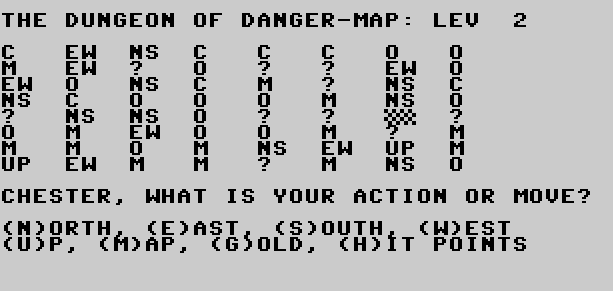 |
| A map of the level. The fuzzy bit in the seventh column is my current position. |
There are some special encounters in the dungeon:
- Rooms with pools of water that might freeze you, do nothing, or burn you
- Thieves who may steal your gold or drop theirs
 |
| That could have been worse. |
- Vapors that might knock you out, causing you to awaken in a random part of the dungeon
- Trap doors that might dump you to the next level (or into a pit if already on Level 2)
All of these events are delivered with maddening pauses between short bursts of text, as if the entire game were narrated by William Shatner.
 |
| Every one of those sets of ellipses is accompanied by a pause as the text loads. |
If you make it to the exit, the game gives you a score based on your gold, how many enemies you killed, and how long it took you. It took me less than an hour to get the highest level (Dungeon Master) on "expert" difficulty.
 |
| I won. I hope someone, somewhere, is happy. |
The Dungeon of Danger appeared as 12 pages of code in a book series called Mostly BASIC by Michigan hobbyist Howard Berenbon. It specifically appeared in the "Book 2" volume for each platform. The earliest seems to be for the Atari 800 in 1980; editions for the Apple II, TRS-80, Commodore PET, and Commodore 64 followed over the next four years.
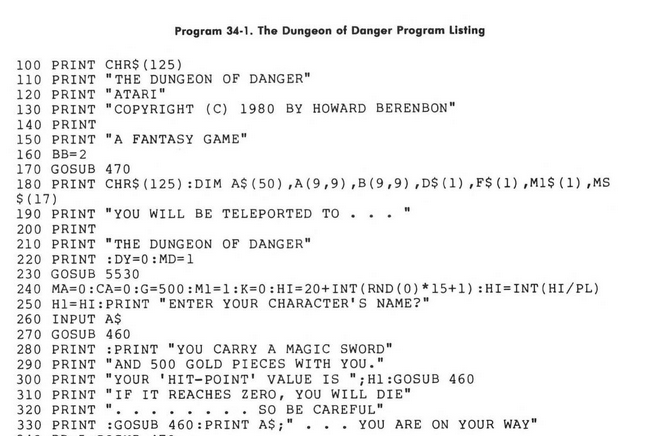 |
| The initial lines of code for The Dungeon of Danger. |
There's no character development, combat is based on random rolls and not any intrinsic attributes, and there's no inventory, meaning that the game fails all my criteria for an RPG. (Frankly, it fails MobyGames's definitions, too, but it's easier to write an entry than to get them to change incorrect information.) It thus earns only a 5 on my GIMLET.
That catches us up to where we were before someone with too much time on his hands decided that The Devil's Dungeon, Knight's Quest, and The Dungeon of Danger needed to be preserved in our memory. Back to Ragnarok and the final entry on Blade of Destiny.
****
Note: An earlier version of this entry, accidentally published before I was ready, was a lot angrier. I was trying to make a joke by which my entries got progressively more ranting and incoherent over the last three games, culminating in my basically frothing at the mouth on this one. I had scheduled all three games a few days in advance. I later decided that people wouldn't get the meta-joke, which was only a little funny in the first place, and removed the setups from the first two entries but neglected to edit the third before it automatically published yesterday. I quickly took it offline to edit out the more irate language. Sorry if you got the premature edition; it would have been confusing.
Thursday, February 13, 2020
Brave Browser the Best privacy-focused Browser of 2019

Out of all the privacy-focused products and apps available on the market, Brave has been voted the best. Other winners of Product Hunt's Golden Kitty awards showed that there was a huge interest in privacy-enhancing products and apps such as chats, maps, and other collaboration tools.
An extremely productive year for Brave
Last year has been a pivotal one for the crypto industry, but few companies managed to see the kind of success Brave did. Almost every day of the year has been packed witch action, as the company managed to officially launch its browser, get its Basic Attention Token out, and onboard hundreds of thousands of verified publishers on its rewards platform.
Luckily, the effort Brave has been putting into its product hasn't gone unnoticed.
The company's revolutionary browser has been voted the best privacy-focused product of 2019, for which it received a Golden Kitty award. The awards, hosted by Product Hunt, were given to the most popular products across 23 different product categories.
Ryan Hoover, the founder of Product Hunt said:
"Our annual Golden Kitty awards celebrate all the great products that makers have launched throughout the year"
Brave's win is important for the company—with this year seeing the most user votes ever, it's a clear indicator of the browser's rapidly rising popularity.
Privacy and blockchain are the strongest forces in tech right now
If reaching 10 million monthly active users in December was Brave's crown achievement, then the Product Hunt award was the cherry on top.
The recognition Brave got from Product Hunt users shows that a market for privacy-focused apps is thriving. All of the apps and products that got a Golden Kitty award from Product Hunt users focused heavily on data protection. Everything from automatic investment apps and remote collaboration tools to smart home products emphasized their privacy.
AI and machine learning rose as another note-worthy trend, but blockchain seemed to be the most dominating force in app development. Blockchain-based messaging apps and maps were hugely popular with Product Hunt users, who seem to value innovation and security.
For those users, Brave is a perfect platform. The company's research and development team has recently debuted its privacy-preserving distributed VPN, which could potentially bring even more security to the user than its already existing Tor extension.
Brave's effort to revolutionize the advertising industry has also been recognized by some of the biggest names in publishing—major publications such as The Washington Post, The Guardian, NDTV, NPR, and Qz have all joined the platform. Some of the highest-ranking websites in the world, including Wikipedia, WikiHow, Vimeo, Internet Archive, and DuckDuckGo, are also among Brave's 390,000 verified publishers.